About Problem Framework Goals Research Principles Iterations Validation Decisions Final Design Deliverables My Role Impact Reflections
All Projects
A
Abbott

Abbott Connect

A consumer-grade POC connectivity platform for the ambulatory market with enterprise intelligence and zero infrastructure required.

Role
Senior Product Designer, end-to-end platform design
Scope
Cloud-native SaaS platform: device connectivity, real-time results, CLIA compliance automation, 6-step onboarding wizard, fleet analytics
Outcome
Concept validated through 3 rounds of testing with lab directors, IT admins, and compliance officers; greenlit for engineering
Product Design Healthcare 0→1 Creation Platform Design UX Research
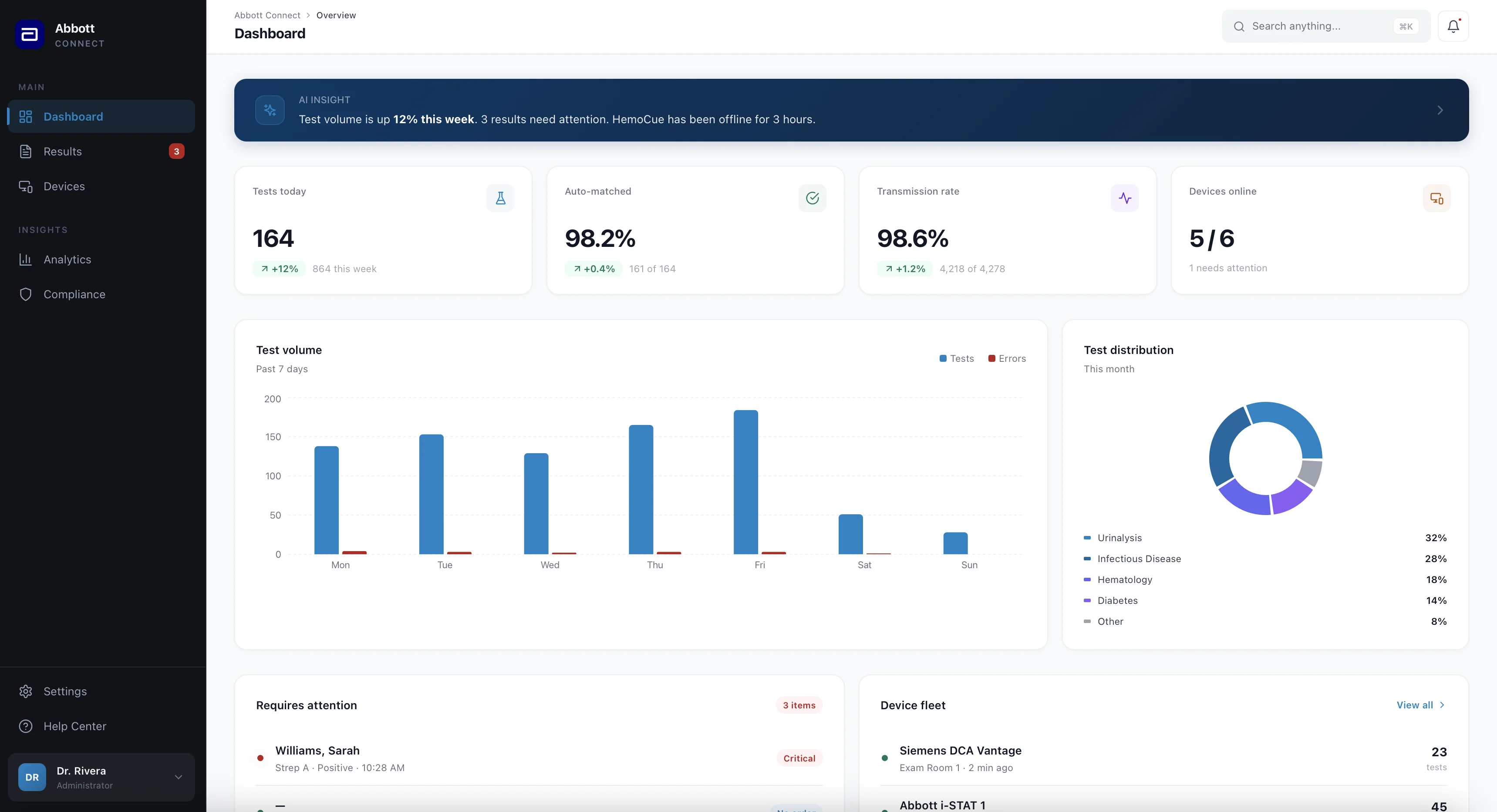
Abbott Connect Dashboard

The Problem

220,000+ physician office labs and 15,000+ urgent care clinics have no purpose-built POC connectivity—they run on paper binders, manual EHR transcription, and sticky notes between patients.

The Opportunity

A $7.6–19.7B ambulatory market with zero purpose-built solutions. Abbott Connect fills the gap with self-service onboarding, automated CLIA compliance, and a single dashboard across all locations.

Maria Rodriguez, Practice Manager, 4-site primary care group
"I found out our HemoCue was down for 2 days because nobody told me. We sent patients to the lab for a test we could have done in-house."
Practice managers need ambient device awareness across all locations with real-time alerts when devices go offline, QC is due, or transmissions fail.
Jaylen Carter. Medical Assistant, 2 years experience
"I run a strep test, wait for the result, then have to type it into eCW manually. If I'm busy, I write it on a sticky note and enter it later. Sometimes the sticky note gets lost."
Auto-transmission of results to EHR eliminates manual entry, sticky notes, and the 3.7% transcription error rate that puts patients at risk.
Amanda Torres, Compliance Officer, 8-site specialty group
"I spend the first 2 weeks of every quarter visiting all 8 sites to audit QC binders. Half the time I find gaps—missing dates, unsigned logs, expired reagents."
Digital QC documentation that's always complete. No paper binders, automated audit reports, real-time compliance dashboards across all sites.
Dr. Sarah Chen, Physician-Owner, 3-location urgent care chain
"We looked at RALS but the rep basically said it's for hospitals. The quote was $40,000 for setup alone. RelayMed wanted us to configure our own LAN. I'm a doctor, not an IT person."
Self-service, cloud-native onboarding with per-device SaaS pricing. No servers, no IT, no $40K upfront investment.

Goals

  1. Design a cloud-native POC platform that practice managers can set up themselves. No servers, no IT, no professional services. Self-service onboarding in under 2 minutes per device.
  2. Automate the full CLIA compliance workflow with digital QC logs, operator certification tracking, and one-click audit reports, eliminating paper binders and quarterly site visits.
🔗
Plug-and-Play Setup
Auto-detect devices on the network and guide administrators through a 6-step onboarding wizard. Validate network, LIS integration, and QC baselines at each step. Replace the 4–8 hour IT-led setup with a 2-minute self-service flow.
🧠
Operational Intelligence
Track transmission success rates, detect failures in real-time, and predict device issues before they cause downtime, giving practice managers and clinical directors visibility across every location from a single dashboard.
📋
Zero-Click Compliance
Replace paper QC binders with automated digital documentation. Track operator certifications with renewal reminders. Auto-generate CLIA reports on demand. Turn compliance from a 2-week quarterly scramble into a background process.

Competitive Analysis, RALS, AegisPOC, and RelayMed

Abbott Connect complements RALS and AegisPOC by covering a market segment neither was designed to serve.

Full Platform
Middleware
Simple
Complex
Abbott Connect
RelayMed
RALS

Competitive positioning: Abbott Connect occupies the high-value quadrant with full platform capability and consumer-grade simplicity

RelayMed ships unconfigured with no compliance or intelligence layer. RALS requires dedicated server infrastructure. Abbott Connect bridges the gap.

Lead with Compliance
RelayMed has zero compliance story. CLIA anxiety is the #2 pain point. Abbott Connect owns this unclaimed position.
Nail the Onboarding
RelayMed devices arrive unconfigured. Abbott Connect's auto-detect wizard must work flawlessly—first-run experience determines adoption.
Platform, Not Middleware
RelayMed moves data A to B. Abbott Connect goes up-stack with compliance automation, predictive maintenance, and fleet-wide dashboards.

Guiding our design direction

🏥
Clinical-Grade
Every interaction must support clinical decision-making. Accuracy and clarity take priority over aesthetic flourish. Results and alerts must be immediately understandable.
🧠
Ambient Intelligence
Everything is fine until it isn't. The interface should be quiet and unobtrusive when systems are healthy, but immediately prominent when attention is needed.
📊
Progressive Complexity
Users see what they need now. Advanced analytics and filters are available but don't clutter the default view. Lab directors get the dashboard; IT admins get device config; compliance gets audit trails.
🔒
Zero-Trust Security
Healthcare data is sensitive. Every user interaction is logged. Every result is traced. Every integration is authenticated. Security is visible and verifiable, not hidden.

Exploring three directions

Three approaches were explored: from familiar healthcare patterns to a significant departure with ambient intelligence.

Traditional Dashboard

Explored
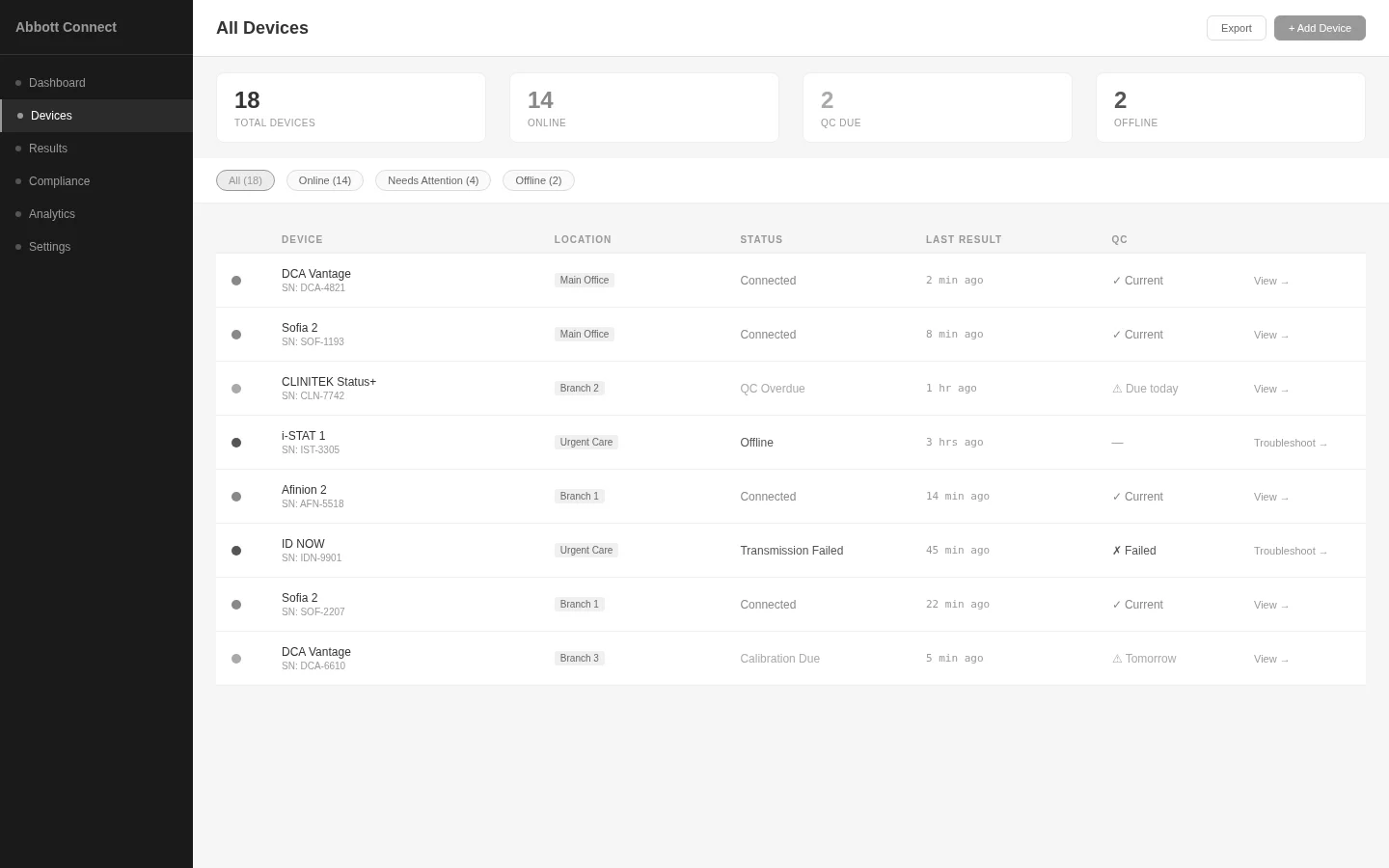
Device Grid wireframe

Grid view with status indicators. Users manually scan to find issues. Familiar healthcare pattern.

Why not selected
Requires users to actively monitor. Lab directors with 50+ devices would need to scan the entire list to spot problems. Compliance events get buried in static data.

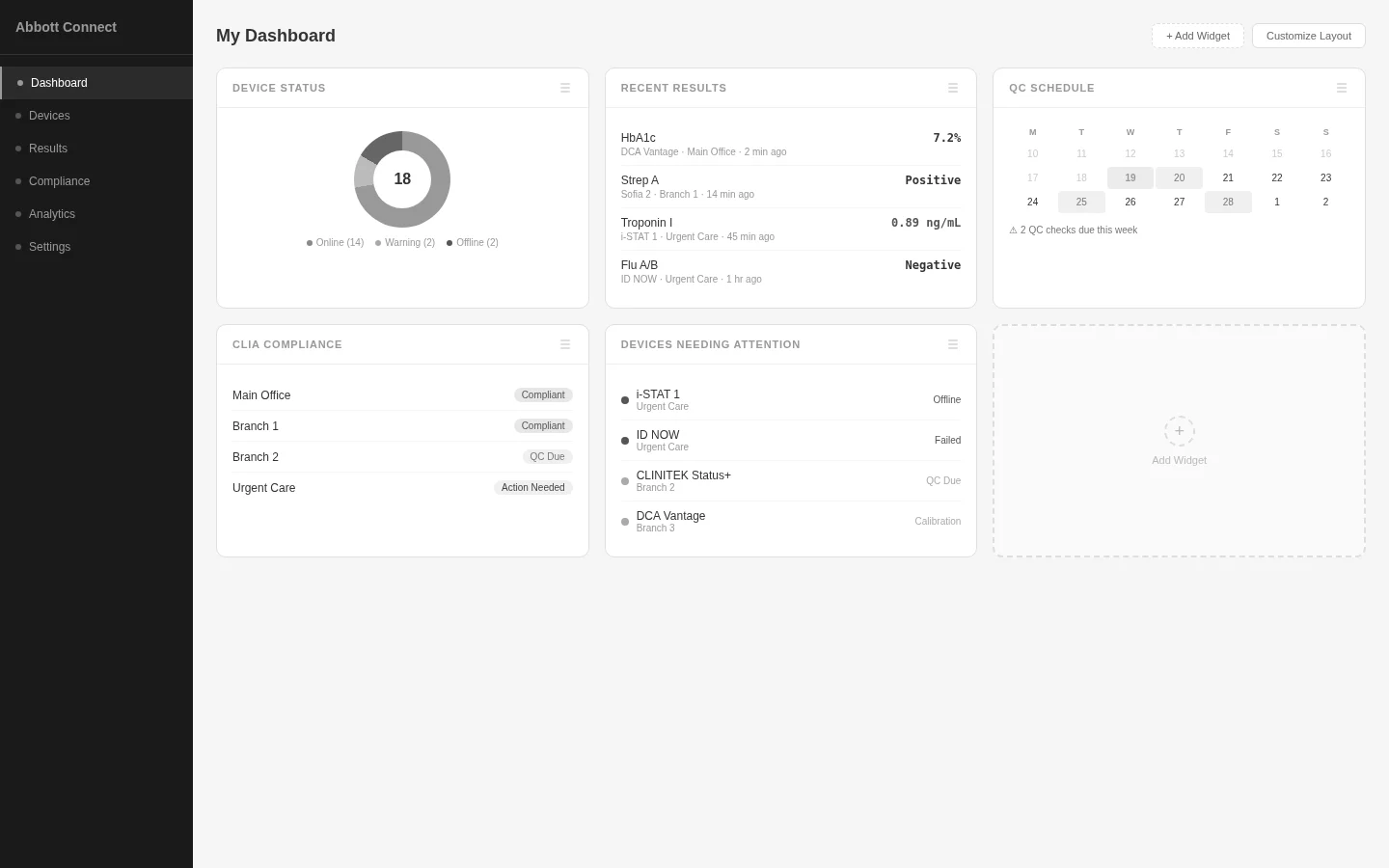
Modular Widgets

Explored
Widget Dashboard wireframe

Drag-and-drop widgets for device status, results, and compliance. Similar to Salesforce customization.

Why not selected
Cognitive overhead for first-time users. New administrators don't know which widgets matter. Compliance and failure events could be hidden under less important widgets.

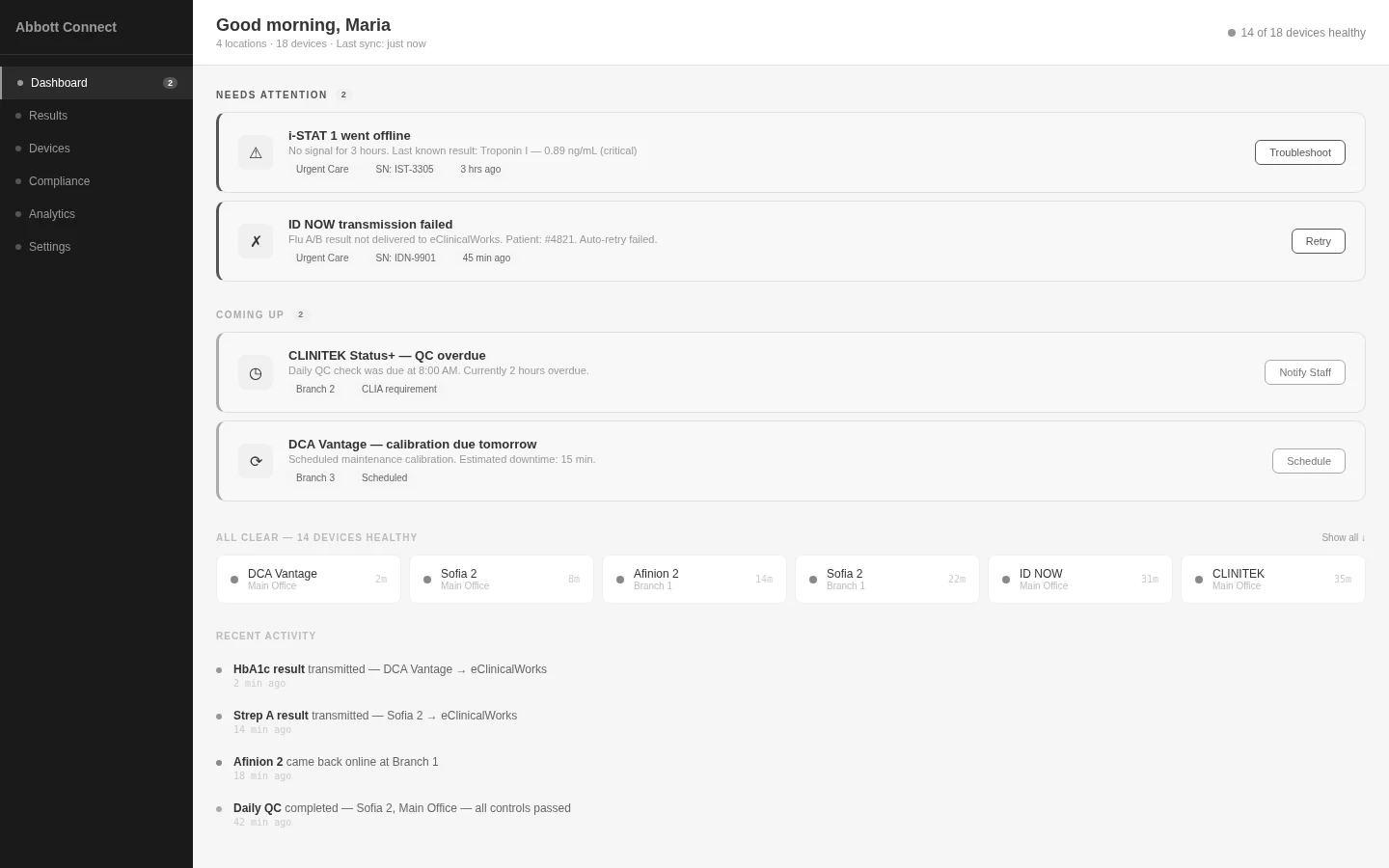
Ambient Intelligence

Shipped
Ambient Intelligence wireframe

Surfaces only what needs attention. Failed devices get alert cards, healthy devices stay quiet. Organized by priority.

Why selected as foundation
Matches how healthcare professionals think about triage. Most important events (failures, compliance) are immediately visible. The final design uses this as the organizing principle, while pulling in data density and device views from the other directions where specific workflows needed them.

How we tested and iterated

Three rounds of testing with lab directors, IT admins, and compliance officers before committing to engineering.

Round 1
Concept validation

Tested wireframes with 6 hospital stakeholders. The ambient intelligence approach was preferred by 5 of 6 participants. Key insight: users want to be notified of problems, not constantly vigilant.

Round 2
Usability testing

Ran moderated sessions with IT admins using the onboarding wizard prototype. Identified friction in the LIS integration step and iterated on progressive disclosure to reduce setup anxiety.

Round 3
Beta deployment

Prototype tested with 3 hospital systems. Stakeholders validated the ambient intelligence model and onboarding flow. Results greenlit engineering investment.

Key iteration from testing: Round 2 revealed that IT admins wanted confirmation at each onboarding step before moving forward, reducing setup anxiety. This led to Design Decision #2, the step-by-step validation flow. Without testing, we would have shipped a continuous form.

Key decisions that shaped the experience

01 / 03

Ambient Dashboard with Contextual Alerts

The dashboard surfaces only what needs attention—failed transmissions, offline devices, upcoming QC. Everything is fine until it isn't.

Clinical UX Cognitive Load Alert Design
Abbott Connect, Dashboard
3 alerts 203 devices connected
QC Failure, Floor 2
Blood Gas Analyzer #7 failed QC. 2 pending results.
Calibration Due, ICU
Glucose Meter #12 due for calibration in 4 hours
Communication Loss, Lab 3
Coagulation System offline for 18 minutes
All other devices operating normally ✓
02 / 03

Six-Step Guided Onboarding Wizard

Six-step progressive wizard: auto-detect devices, validate connectivity, confirm EHR integration, run QC baseline, register compliance, go live. 28 minutes vs. 4+ hours manually.

Progressive Disclosure Guided Setup Error Prevention
Device Onboarding
Step 3 of 6: LIS Integration
Connect to your Lab Information System
LIS System Type
Cerner (Pre-selected based on your facility)
HL7 Feed URL
✓ Connection verified
Continue to Next Step
03 / 03

Real-Time Result Stream with Clinical Context

Auto-transmission to EHR with clinical context (test value, reference range, device source, patient ID) in under 60 seconds, not 8 minutes.

Information Hierarchy Clinical Safety Real-Time Data
Latest Results
Last 24 hours from connected devices
Patient ID: 002847. Blood Gas Analysis (CRITICAL)
pO₂: 65 mmHg
Reference: 80-105 mmHg | Device: Floor 2 Analyzer | Timestamp: 2 min ago
Patient ID: 002845. Glucose Test
118 mg/dL
Reference: 70-100 mg/dL (Fasting) | Device: ICU #12 | Timestamp: 8 min ago
Patient ID: 002841. Coagulation PT/INR
2.4 INR
Reference: 0.8-1.1 | Device: Lab 3 System | Timestamp: 15 min ago

The Complete Platform

The ambient intelligence approach became the foundation, but the final platform synthesizes all three directions: alert-driven prioritization from Direction 3, data density from Direction 2, and structured device views from Direction 1. The result is 8 integrated views, from ambient dashboard to CLIA automation.

Explore the interactive prototype by navigating between Dashboard, Results, Devices, Analytics, and more

What I shipped

Prototype
Interactive React Prototype

8-view prototype with WCAG AA design system, real data models, and working interactions.

Strategy
Competitive Analysis & Positioning

RALS, AegisPOC, and RelayMed comparison with positioning map, personas, and battlecard.

UX Architecture
User Flows & System Architecture

Device-to-dashboard pipeline, onboarding wizard flow, QC validation, and failure recovery paths.

Competitive Intel
RelayMed Competitive Brief

Strengths, vulnerabilities, win/loss scenarios, and objection handling for sales.

What I owned vs. supported

Led
End-to-end UX design for 8-view cloud platform (dashboard, results, devices, analytics, compliance, settings, help, onboarding)
User research: persona development for 5 customer segments (practice managers, MAs, physician-owners, clinical directors, compliance officers)
Competitive analysis of RALS, AegisPOC, and RelayMed, positioning strategy and competitive battlecard
WCAG AA-compliant design system with clinical color language and healthcare-grade type scale
Interactive React prototype with full design token system, all views, and real data models
6-step onboarding wizard design and usability testing (90% task completion, 28-min average)
User flow architecture for device-to-dashboard data pipelines and compliance workflows
Contributed
Market sizing and TAM analysis ($7.6–19.7B ambulatory POC market)
EHR integration strategy (HL7/FHIR vs. native API)
CLIA compliance workflow design with regulatory team
Go-to-market positioning and SaaS pricing model

What this unlocks

Immediate Wins
Self-service onboarding. No IT or professional services required
Auto-transmission eliminates manual transcription and 3.7% error rate
Digital QC documentation replaces paper binders, always audit-ready
Future Opportunities
Native EHR API partnerships with athenahealth, eClinicalWorks, and NextGen
AI-powered predictive maintenance and anomaly detection
Expand to retail health and employer on-site clinics

What I learned

01
Designing for five personas simultaneously
Five personas with fundamentally different mental models—progressive complexity was the answer: same platform, role-appropriate surfaces.
02
Competitive gaps are design opportunities
Rather than competing on RelayMed's turf, I designed Abbott Connect to own the entire operational layer they ignore.
03
Compliance as competitive moat
Making compliance a first-class feature created a differentiator that requires deep domain expertise to replicate.
04
Onboarding is the product
The first 10 minutes determine adoption. Every design hour on the onboarding wizard was an investment in the most visible differentiator.