Perpetual futures trading on Robinhood
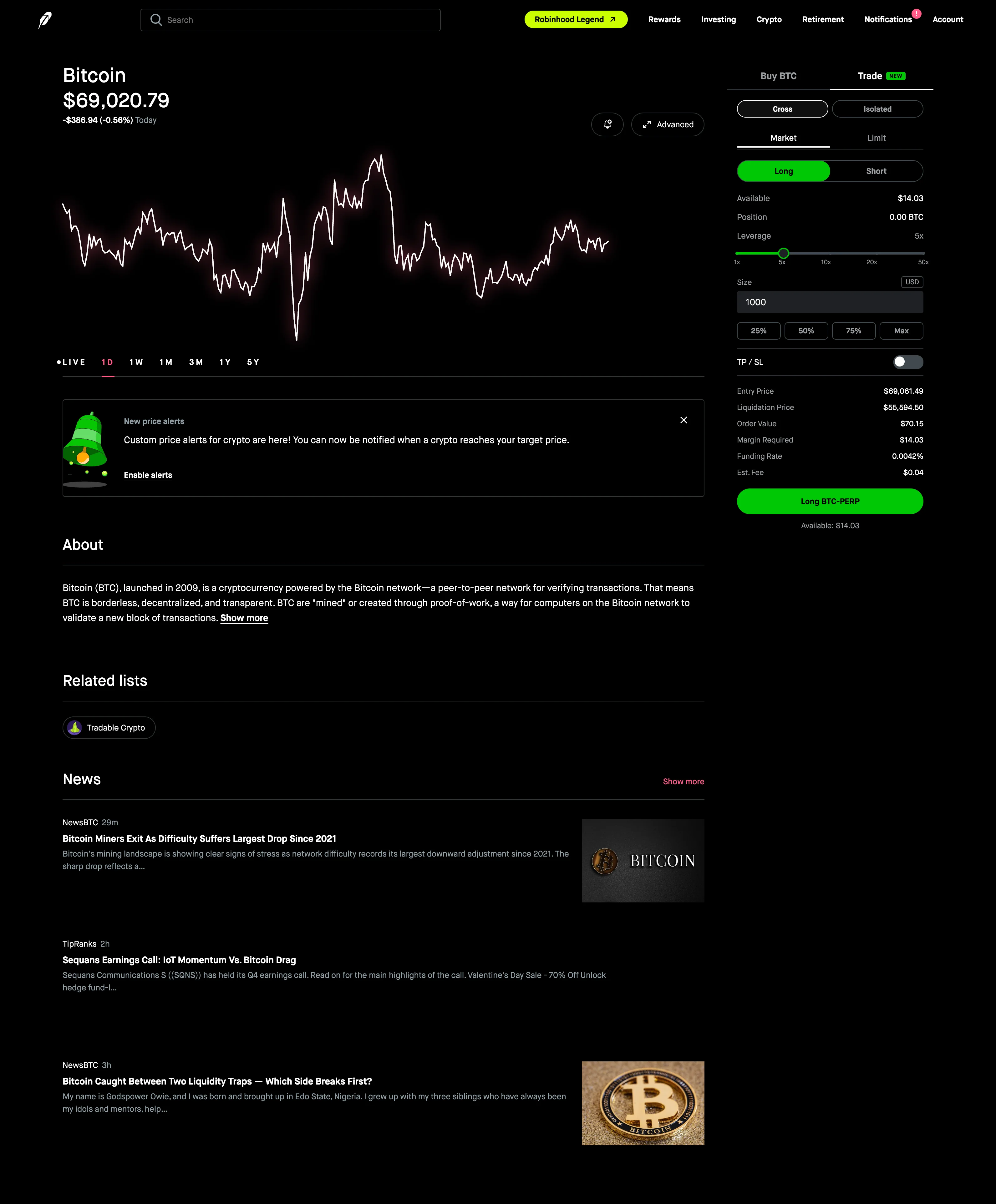
A concept exploring how Robinhood could integrate perpetual futures (perps) into its existing crypto experience. The goal: make exchange-grade derivatives accessible through a familiar, retail-friendly interface.
What are perpetual futures?
Perpetual futures, commonly called "perps," are a type of derivative contract that lets you bet on the price of an asset without ever owning it. Unlike traditional futures that expire on a set date, perps have no expiry. You can hold a position for as long as you want, paying or receiving a small funding rate every few hours to keep the contract price tethered to the spot price.
They're the single most traded instrument in crypto. On exchanges like Binance and Hyperliquid, perps regularly do more daily volume than spot trading. Traders use them to go long, go short, or hedge existing positions, often with leverage ranging from 2x to 50x or more.
Robinhood already has 24/7 crypto trading and a growing derivatives business with options. Perps are a natural next step and would open the door to a massive new revenue stream from funding fees and liquidations.
Sidepanel that lives alongside spot
Rather than hiding perps in a separate section, the concept adds a "Trade" tab next to the existing "Buy BTC" panel. This keeps the experience unified. A user browsing Bitcoin's spot price can seamlessly switch to placing a leveraged trade without navigating away.
The panel also surfaces key information upfront: funding rate, estimated fees, liquidation price, and order value. This transparency matters because one of the biggest criticisms of existing perps platforms is that they bury critical risk info or assume users already understand it.
Perps don't have to stop at crypto
One of the most interesting possibilities is applying the perps model beyond crypto. Perpetual futures contracts could theoretically be built for any tradeable asset. Stocks, commodities, forex, even prediction markets. The mechanics are the same: no expiry, leverage, funding rates to track the underlying price.
- BTC-PERP, ETH-PERP, SOL-PERP. The usual suspects, already proven on every major exchange
- Memecoins, DeFi tokens, new listings. Perps let users trade exposure without bridging to a DEX
- Stock perps. Imagine SPY-PERP or TSLA-PERP with 24/7 trading and leverage, no options chain needed
- Commodity perps. Gold, oil, natural gas exposure without futures contract rollovers
- Forex perps. EUR/USD, GBP/JPY with the simplicity of crypto-style trading
Platforms like Hyperliquid are already exploring this territory on-chain. Robinhood, with its existing regulatory relationships and brokerage infrastructure, could be in a unique position to bring these products to a mainstream audience in a compliant way.
Potential issues and risks
Even if the regulatory path clears, there are real product and reputational risks Robinhood would need to navigate carefully.
- Liquidation cascades. Leveraged traders can get liquidated quickly in volatile markets. If Robinhood's liquidation engine isn't rock-solid, it could lead to socialized losses or insurance fund depletion, both terrible for user trust.
- User education gap. Robinhood's core audience is retail-first. Many users won't understand leverage, margin calls, or funding rates. The product would need aggressive in-app education, risk warnings, and possibly gating based on experience level.
- Brand risk. Robinhood has already faced backlash for "gamifying" investing. Adding 50x leverage to a platform known for accessibility could draw heavy scrutiny from regulators, media, and consumer advocates.
- Oracle dependency. Perps need reliable price feeds to calculate mark prices and trigger liquidations. A faulty or delayed oracle can cause unjust liquidations, a problem that has plagued even major exchanges.
This is a product concept and personal exploration, not affiliated with Robinhood. The design was built to imagine what a compliant, retail-friendly perps experience could look like inside an app millions of people already use.